
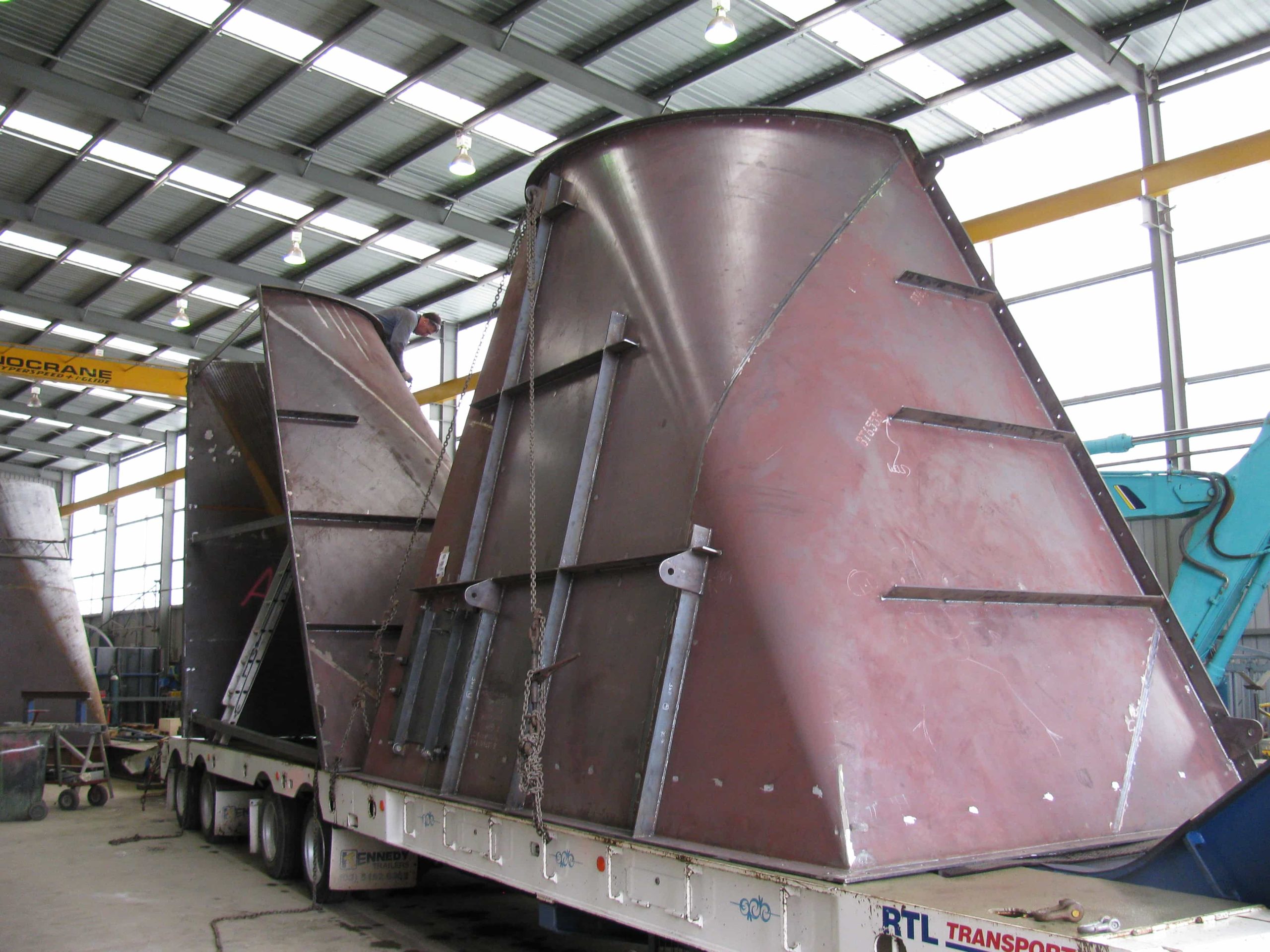
Hulls Engineering Australia provides mild steel silo fabrication in Leongatha, with briefs covering material data, coatings, access and installation scope.
A silo enquiry based only on capacity leaves major design, pricing and scope questions unanswered. For mild steel silo fabrication, the brief should define the stored material, operating duty, physical interfaces, site conditions and required deliverables. We need this information early to review the intended workshop and installation scope without relying on conflicting assumptions.
What Information Must a Silo Fabrication Brief Include?
The brief must identify the bulk solid, working capacity, filling method and required discharge performance. Capacity should be stated by volume and mass where possible because bulk density, moisture and consolidation can change the load and usable storage requirement. The University of Wollongong’s bulk-solids research identifies flow properties, wall loads, outlet geometry, feeder interfaces and wear as connected design considerations.
- Stored-material name, composition and relevant safety data
- Loose and compacted bulk density
- Particle-size and moisture ranges
- Normal and maximum material temperatures
- Working capacity and total capacity
- Fill rate, discharge rate and operating cycles
- Abrasive, corrosive, cohesive or dust-forming characteristics
- Tendency to bridge, cake, segregate or flood
- Available flow-test results or a representative product sample
Outlet design basis: State whether tested flow data or engineering analysis will determine hopper angles and outlet dimensions, rather than treating a generic arrangement as suitable for every product.
Future material changes: Identify other bulk solids the silo may store because a system developed for one product may not suit another.
How Should the Silo Connect with the Existing Plant?
Define the inlet, outlet and equipment interfaces before fabrication, including filling, venting, dust collection, level monitoring, discharge and pressure requirements. Provide the silo location, footprint, supports, surrounding structures, transport and lifting access, plus maintenance and safety access needs. Clearly assign responsibility for engineering, foundations, electrical work, freight, erection and commissioning.
Which Workshop and Quality Requirements Need Definition?
Accurate mild steel silo fabrication depends on a controlled workshop specification and objective acceptance criteria. Our engineering and fabrication services list tanks and silos in stainless and mild steel, along with grit-blasting, painting, general mild-steel work and on-site installation, assembly and commissioning. Our in-house machinery includes plate rolls, a press brake, a guillotine, gantry cranes and CNC plasma and oxy profile cutting.
- Steel grade, engineered thicknesses and dimensional tolerances
- Approved drawings, revisions and fabrication hold points
- Welding procedures, inspection and required non-destructive testing
- Internal lining, coating or surface-finish requirements
- External preparation, paint system, colour and inspection criteria
- Nozzles, vents, flanges, manways and lifting points
- Material certificates, weld records and coating documentation
- Transport splits, field joints and assembly requirements
Applicable standards: The project engineer should nominate the relevant design, fabrication, welding and access standards.
Inspection and testing: Write the required checks and acceptance criteria into the brief instead of requesting compliant or fully tested fabrication.
Hulls Engineering Australia for Mild Steel Silo Fabrication
With Hulls Engineering Australia, a structured brief gives us a clearer basis for reviewing the required fabrication and installation scope. We can assess the enquiry against the supplied material data, drawings, operating requirements, site information and responsibility matrix. Project-specific engineering, coatings, inspections and verification requirements should be confirmed before the fabrication scope is finalised.
Request a project quote with your silo requirements, preliminary drawings, material data and site details.